In this article
A refrigerator not cooling is most often a cleaning problem, not a broken part. Dust-packed condenser coils, a stalled fan or a frosted-over evaporator cause the large majority of warm-fridge calls, and the first one costs nothing to fix. This guide walks you through the checks in the order a technician would do them, explains what each symptom points to, and shows what a repair typically costs if you need a pro.
Why Is My Refrigerator Not Cooling? 9 Common Causes
A fridge cools by pumping refrigerant through two coils. The evaporator coil (behind the freezer panel) absorbs heat from inside the cabinet; the condenser coil (underneath or at the back) releases that heat into your kitchen with help from a small fan. Anything that blocks airflow over either coil, or stops the refrigerant from moving, makes the cabinet warm up.
| # | Cause | Typical symptom | DIY? |
|---|---|---|---|
| 1 | Wrong setting or power issue | Light on, little or no cold air | Yes |
| 2 | Dirty condenser coils | Runs constantly, gradually loses cold | Yes |
| 3 | Blocked air vents | Some shelves warm, others fine | Yes |
| 4 | Worn door gasket | Condensation, frost near the door | Yes |
| 5 | Condenser fan failed | Compressor hot, no fan noise at the bottom | Usually |
| 6 | Evaporator fan failed | Freezer cold, fresh-food side warm, no airflow | Usually |
| 7 | Defrost system fault | Frost or ice on the freezer back panel | Sometimes |
| 8 | Start relay or compressor | Clicking every few minutes, compressor won’t stay on | Relay yes, compressor no |
| 9 | Refrigerant leak or sealed-system fault | Everything runs, nothing gets cold | No |
1. Check the settings and power first
A bumped dial, a “demo” or “showroom” mode, or a tripped GFCI outlet causes plenty of service calls. The FDA recommends keeping the fresh-food section at 40°F or below and the freezer at 0°F. Put an appliance thermometer in a glass of water on the middle shelf and read it after 24 hours to know the real temperature.
2. Clean the condenser coils (the most common fix)
The condenser coil gets very little attention, yet it is vital. When it is coated in dust, pet hair and kitchen grease, heat can’t escape, so the compressor runs longer and the cabinet slowly warms. Homes with pets or lots of dust may need this every 2–4 months; most kitchens are fine with twice a year. A fridge that has gone ten years without a cleaning can have coils packed solid, and cleaning alone often brings it back to normal.
- Remove the access panel. On most models the coil sits at the bottom rear behind a panel held by a few screws or bolts. Some have the coil behind the front kick plate instead.
- Unplug the refrigerator. There is wiring and a spinning fan right next to the coil. Never touch anything back there while it is plugged in.
- Vacuum. Use a household vacuum with a soft brush attachment. Work around the copper refrigerant lines; bending or nicking them can cause a leak.
- Brush the hidden side. Many coils are rounded or layered, so a vacuum only reaches the front. A long, bendable coil brush (the same kind used for dryer lint) lets you curve around the back and top and pull the dust out.
- Blow out the deep layers (optional). If you have an air compressor, remove the front kick plate, set a vacuum hose under the front of the fridge and pack towels around it. Then blow air through the coil from the back so the dust is pushed forward into the vacuum instead of across the kitchen.
- Use a no-rinse coil cleaner as a last resort. Most coil sprays are designed for outdoor AC units and need rinsing with water, which you don’t want indoors. If dust is still caked on after brushing, choose a foaming cleaner labeled no-rinse.
- Reassemble and cool down. Refit the panel, plug the fridge back in and press “fast cool” or “turbo cool” if your model has it. Give it 12–24 hours to reach temperature before judging the result.
3. Free up blocked vents
Cold air enters the fresh-food side through vents, usually high on the back wall or between the freezer and fridge. A gallon of milk or a tightly packed shelf in front of them starves the rest of the cabinet. Leave a few inches of space around each vent.
4. Test the door seals
Close the door on a dollar bill. If it slides out with no resistance, that part of the gasket is leaking. Clean the gasket with warm soapy water, warm a creased section with a hair dryer to reshape it, and replace it if it is torn. A door that sags can also stop the seal from closing; see our guide on how to adjust a fridge door.
5. Make sure the condenser fan spins
With the back panel off and the fridge running, the small fan next to the compressor should spin whenever the compressor runs. If it is stopped, unplug the fridge and turn the blade by hand. A stiff or noisy motor, or one that won’t start, needs replacing.
6. Check the evaporator fan
This fan lives behind the rear panel inside the freezer and pushes cold air into both compartments. Open the freezer door and press the door switch: you should hear and feel the fan. If the freezer is cold but the fresh-food side is warm and there is no airflow from the vents, the evaporator fan is the usual suspect.
7. Look for frost on the evaporator coil
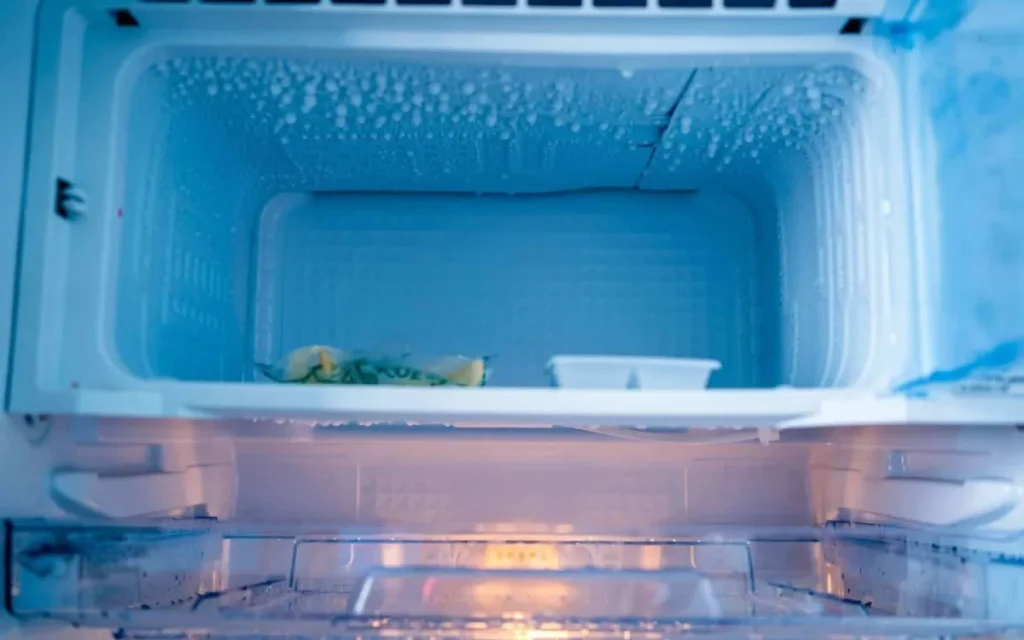
A thick layer of frost on the freezer’s back panel, or ice blocking the air duct, means the automatic defrost system has failed (heater, thermostat, or control board). As a test, empty the fridge, unplug it with the doors open for 24–48 hours and towel up the meltwater. If it cools well for a week or two and then warms again, a defrost part needs replacing.
8. Listen for clicking at the compressor
If you hear a click every few minutes and the compressor at the bottom is hot but not running, the start relay (a small part plugged onto the side of the compressor) has likely failed. Relays are inexpensive and easy to swap. If a new relay doesn’t help, the compressor itself may be failing, which is a job for a technician.
9. Suspect a sealed-system problem last
When the fans and compressor run, the coils are clean and nothing gets cold, a refrigerant leak or a blocked line is possible. Only an EPA-certified technician can recover and recharge refrigerant, and on older units this repair often costs more than the fridge is worth.
Fridge Warm but Freezer Cold: What It Means
Because the fresh-food side gets its cold air from the freezer, a cold freezer with a warm fridge almost always points to an airflow fault between them:
- Evaporator fan not running — no air is pushed through the vents.
- Frosted evaporator coil — ice blocks the air path (defrost system fault).
- Damper stuck closed — the flap that lets cold air into the fridge section isn’t opening.
- Food blocking the vents — the simplest fix of all.
Samsung, LG, Whirlpool and Other Brands
The checks above apply to every major brand, but each has a few known weak spots:
- Samsung: French-door models are known for ice building up on the evaporator and blocking the fan (see our Samsung fridge cooling guide). Also rule out demo mode, which runs the lights but not the cooling.
- LG: Many LG models use an inverter linear compressor. If the fans run but nothing gets cold, have it diagnosed while the extended compressor warranty may still apply (see our LG fridge test-mode guide).
- Whirlpool, Maytag, KitchenAid: Dirty condenser coils, failed evaporator fans and defrost faults are the top causes (see our Whirlpool fridge fixes).
- GE and Frigidaire: Condenser fan motors and defrost problems are common, and Frigidaire models often have a damper that freezes shut (see our Frigidaire damper guide). On side-by-sides the coils are often behind the front grille.
What It Costs to Fix a Fridge That Won’t Get Cold
Ranges below combine 2025–2026 published repair-cost guides and typical U.S. technician pricing, including parts and labor. Your price depends on brand, part access and local labor rates.
| Repair | Typical cost |
|---|---|
| Diagnostic / service call | $75 – $150 (often credited toward the repair) |
| Professional coil cleaning | $75 – $150 |
| Door gasket replacement | $150 – $350 |
| Condenser fan motor | $150 – $350 |
| Evaporator fan motor | $200 – $400 |
| Defrost heater, thermostat or timer | $200 – $450 |
| Start relay | $100 – $250 |
| Control board | $250 – $600 |
| Refrigerant leak repair and recharge | $400 – $1,200 |
| Compressor replacement | $800 – $1,800 |
Repair or replace? A common rule: if the fridge is past about two-thirds of its expected life (most last 10–15 years) and the repair costs more than half the price of a comparable new model, replacing it usually makes more sense. Fans, relays, gaskets and defrost parts are almost always worth fixing; a compressor on a 12-year-old unit usually isn’t.
When to Call a Repair Pro
Call a technician if the compressor is hot and won’t stay on, you suspect a refrigerant leak, the fridge still warms up after a full defrost and a coil cleaning, or the control panel shows an error code you can’t clear. If food is at risk, ask for same-day service and move perishables to a cooler with ice in the meantime.
Find refrigerator repair companies Get free quotes Same-day service
Questions and Answers
How much does it cost to fix a refrigerator not cooling?
Most repairs land between $150 and $450, for example a fan motor, defrost part or start relay. Coil cleaning can cost nothing if you do it yourself. Compressor and refrigerant repairs are the expensive end at $800 to $1,800.
Why is my fridge not cooling but the freezer is cold?
Cold air isn’t reaching the fresh-food side. The usual causes are a stopped evaporator fan, frost blocking the evaporator coil, a stuck damper, or food covering the vents.
Why is my fridge running but not getting cold?
If the compressor hums but the cabinet stays warm, check for dirty condenser coils and a stopped condenser fan first. If both are fine, a sealed-system issue such as a refrigerant leak may be the cause.
Should I unplug my fridge if it stops cooling?
Unplugging it for 24–48 hours with the doors open is a useful test for frost buildup. Move your food to a cooler first. If cooling returns after the defrost, the automatic defrost system needs repair.
How often should I clean refrigerator condenser coils?
Twice a year for most homes, and every 2–4 months if you have pets or a dusty kitchen. Clean coils help the fridge cool faster and use less energy.
Why did my fridge stop cooling after a power outage?
Give it up to 24 hours to recover. If it still won’t cool, a power surge may have damaged the control board or start relay. Check that the outlet and breaker are working, too.
How long does a fridge take to get cold again?
After cleaning or a defrost, most refrigerators reach 40°F within 6–12 hours and fully stabilize within 24 hours. The fast-cool setting speeds this up.
Why is my fridge clicking and not cold?
A click every few minutes from the bottom rear usually means the start relay is trying to start the compressor and failing. Replacing the relay is a low-cost fix; if that doesn’t work, the compressor may need attention.
Can low refrigerant make a fridge warm?
Yes, but it is less common than airflow problems because a fridge’s sealed system doesn’t normally lose refrigerant. A leak needs a certified technician to find, repair and recharge.
Is it worth repairing a 10-year-old refrigerator?
For fans, relays, gaskets and defrost parts, yes. For a compressor or sealed-system repair on an older unit, compare the quote with the price of a new, more efficient model.
The Bottom Line
Before you call anyone about a refrigerator not cooling, unplug it and clean the condenser coils, then check the setting, the vents, the door seals and both fans. Those steps solve most warm-fridge problems for little or no money. If you find frost, a clicking compressor or no cooling at all with everything running, get a technician’s diagnosis and compare at least two quotes.
About This Guide
This guide was written by David C, Senior Technical Writer at Repairior, from hands-on appliance troubleshooting steps and reviewed by our editorial team. Temperature guidance follows FDA food-safety recommendations, and cost ranges reflect published 2025–2026 U.S. repair pricing. We update our guides when pricing or best practices change, and we don’t accept payment for placement in our recommendations.
Compare reviewed refrigerator repair companies and request free quotes in minutes.